I enjoyed this video for sharp writing, clarity of data presentation, and measured tone.
While still relying on economic markets for a thriving food economy, we nonetheless can expect our major grocery chains to do better on wages. No matter what one thinks of the proposed federal minimum wage increase, it is clear that the nation's leading employers should face binding social norms that constrain them to pay wages that reach a certain threshold.
What should the threshold be? It is possible that some threshold would be too high, counter-productively putting grocery companies out of business. But, this video focuses on a much more humble and minimal threshold. At the very least, major grocery chains should pay wages sufficiently high to keep workers off the Supplemental Nutrition Assistance Program (SNAP) rolls.
Showing posts with label labor. Show all posts
Showing posts with label labor. Show all posts
Monday, April 7, 2014

Saturday, November 23, 2013
Report and audit from the Fair Food Standards Council
The Fair Food Standards Council this week published its first report and audit from the Fair Food Program.
This report explains the operations, monitoring, and auditing of the agreements that the Coalition of Immokalee Workers (CIW) has reached with selected major food manufacturers, restaurant chains, and food retailers. Through these agreements, farm workers are able to protect their rights and earn a wage premium for part of their work (for example, they may earn a bonus per bucket on tomato harvest). The report includes inspiring accounts of the difference these agreements can make, on issues ranging from getting paid for the full amount of time on worksite to protecting women from risk of rape by a crew boss.
Previous posts on this blog describe my visits to the CIW in Florida in 2009 and 2012, which have affected how I think and teach about labor issues in the U.S. food system. Barry Estabrook includes an engaging account of these labor issues in Tomatoland.
The new report on the Fair Food Program includes more detail than I have previously seen about how the fair food premiums are recorded, distributed, and audited. I had been wanting to read about these audits, which increase my confidence in the pass-through mechanism for the premium -- the brand-name companies must pay tomato grower enterprises, which must pass along the correct amount to the workers (minus a specified deduction for the paper-work and transactions costs). The CIW is able to reach such agreements with brand-name food and restaurant companies (which have a public reputation to protect), while it would have been more difficult to win agreement on a premium directly from the growers (who operate in a cut-throat competitive market). I found it illuminating to see an exhibit with a photograph of an actual pay stub recording the premium. Understanding this slightly convoluted system better, it is easier to think of it as a feasible business model worth expanding to other areas of U.S. farm labor.
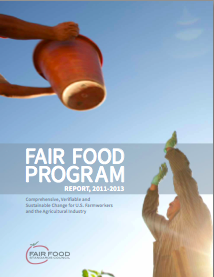
This report explains the operations, monitoring, and auditing of the agreements that the Coalition of Immokalee Workers (CIW) has reached with selected major food manufacturers, restaurant chains, and food retailers. Through these agreements, farm workers are able to protect their rights and earn a wage premium for part of their work (for example, they may earn a bonus per bucket on tomato harvest). The report includes inspiring accounts of the difference these agreements can make, on issues ranging from getting paid for the full amount of time on worksite to protecting women from risk of rape by a crew boss.
Previous posts on this blog describe my visits to the CIW in Florida in 2009 and 2012, which have affected how I think and teach about labor issues in the U.S. food system. Barry Estabrook includes an engaging account of these labor issues in Tomatoland.
The new report on the Fair Food Program includes more detail than I have previously seen about how the fair food premiums are recorded, distributed, and audited. I had been wanting to read about these audits, which increase my confidence in the pass-through mechanism for the premium -- the brand-name companies must pay tomato grower enterprises, which must pass along the correct amount to the workers (minus a specified deduction for the paper-work and transactions costs). The CIW is able to reach such agreements with brand-name food and restaurant companies (which have a public reputation to protect), while it would have been more difficult to win agreement on a premium directly from the growers (who operate in a cut-throat competitive market). I found it illuminating to see an exhibit with a photograph of an actual pay stub recording the premium. Understanding this slightly convoluted system better, it is easier to think of it as a feasible business model worth expanding to other areas of U.S. farm labor.
Wednesday, September 25, 2013
Why it is difficult to develop good SNAP policy
When legislators want to make cuts to the Supplemental Nutrition Assistance Program (SNAP), they don't write in a change to an appropriated dollar amount. Instead, because the program is a "mandatory" or entitlement program, they change the eligibility and benefit rules in some particular way, and then the Congressional Budget Office "scores" the change to provide an estimate of the budgetary change that is generated.
When House Republicans proposed this summer to cut SNAP, the particular legislative vehicle was a proposal by Rep. Steve Southerland (R-FL) to increase work requirements. Democrats opposed the change, not so much because of an objection to work requirements, but rather because the proposal was first and foremost the vehicle for SNAP cuts. In the past, proposals for work requirements that weren't about cutting program rolls have sometimes had broad support and sometimes not.
In the Washington Post today, Eli Saslow has an excellent feature about Southerland and his interest in work requirements. The article has two especially captivating passages. The first passage is a conversation between Southerland and low-income participants in a job readiness program. I sometimes read a promising reform proposal from a constituency that is not traditionally a core program supporter (whether budget-cutting conservatives, or whether nutrition-promoting public health advocates) and think to myself, "This promising proposal certainly could be strengthened if the sponsors would first vet it with program participants themselves, then make some modifications so that the proposal really could be even more relevant to people's needs, rather than just what an outsider thinks they need."
The second captivating passage is about how Southerland, though he has the courage to speak to program participants, lacks the ability to speak to program supporters in Congress:
I want to shout, "Take a risk, Mr. Southerland!" You are thinking clearly about important issues. You are getting out in the field to speak to real people. Why, then, restrict your policy conversations to government-hating anti-poor conservatives in the majority caucus of the House of Representatives? Perhaps you have a calling in educating and persuading instinctive liberals about a genuinely helpful vision of a social safety net that gives an honored central place to hard work.
When House Republicans proposed this summer to cut SNAP, the particular legislative vehicle was a proposal by Rep. Steve Southerland (R-FL) to increase work requirements. Democrats opposed the change, not so much because of an objection to work requirements, but rather because the proposal was first and foremost the vehicle for SNAP cuts. In the past, proposals for work requirements that weren't about cutting program rolls have sometimes had broad support and sometimes not.
In the Washington Post today, Eli Saslow has an excellent feature about Southerland and his interest in work requirements. The article has two especially captivating passages. The first passage is a conversation between Southerland and low-income participants in a job readiness program. I sometimes read a promising reform proposal from a constituency that is not traditionally a core program supporter (whether budget-cutting conservatives, or whether nutrition-promoting public health advocates) and think to myself, "This promising proposal certainly could be strengthened if the sponsors would first vet it with program participants themselves, then make some modifications so that the proposal really could be even more relevant to people's needs, rather than just what an outsider thinks they need."
The second captivating passage is about how Southerland, though he has the courage to speak to program participants, lacks the ability to speak to program supporters in Congress:
He explained that he had spent the past few days studying 20 years of food stamp policy, trying to differentiate himself from his colleagues by becoming an expert. “Nobody here really knows anything,” he said. He thought about that for a second and then reconsidered. “There’s one other guy,” he said. “A Democrat.” He told her about a Massachusetts liberal named Jim McGovern, who had been giving a speech about hunger on the House floor each week. McGovern had rallied the Democrats against Southerland’s proposal. Out of 435 people in the House, he was the only one who had studied food stamps just as hard and who seemed to care just as much.This totally matches my own impressions about what is going wrong in Congressional politics in the United States on all the important food policy issues of the day.
“What does he say about all of this to you?” his daughter asked. “I don’t know,” Southerland said. “I haven’t talked to him.”
“What?” she said. “Seriously? Never? That doesn’t make sense.” She knew her dad as a conciliator who valued mentoring young men at church, yearly hunting trips with his three siblings and funeral director retreats to the mountains. “Your whole thing is connecting with people,” she said.
“Everybody likes you.” And yet here was another Washington lawmaker, elected to solve the same problems, who had become an expert on the same issue, who worked in the same place, and her dad had never met with him?
“Can’t you ask him to coffee?” she asked. “You could work together.”
“That wouldn’t play so well with the conservative base,” Hayes said.
“Or back in district,” McCullough said.
“Honey, look,” Southerland said, staring at her intently, pleading with her to understand. “Washington is a runaway freight train. There isn’t time here for anything.” He reached for two empty milkshake glasses to help him illustrate the problem, setting the glasses side by side on the table, their rims touching. “This is me, and this is the other guy when we get to Washington,” he said. “Different ideas, different people, but we are close. We are touching. Democrat and Republican. We can do something with this.”
He started to slowly pull the glasses in separate directions, ticking off reasons for the escalating divide. “Fundraising. Campaigns,” he said, moving the glasses farther apart. “Votes, strategy, rushing around, lobbyists, name-calling,” he continued, spreading the glasses farther, moving his daughter’s plate to clear a path for one of them. “I have my meetings and they have theirs. I run by them. They run by me. It’s all about winning, winning, winning. Winning – not fixing problems – defines all.”
Now Southerland stretched his arms as far as he could, placing each glass at a distant edge of the table. Each was just an inch from falling and shattering on the ground. This was the congressional divide over food stamps and so much else. This was Washington in 2013 – one place, Southerland was beginning to realize, where legislation depended on so much more than hard work.
“So now I’m here and they’re way over there,” he said, pointing to the glasses. “We can barely see each other. We can’t solve anything like this.”
I want to shout, "Take a risk, Mr. Southerland!" You are thinking clearly about important issues. You are getting out in the field to speak to real people. Why, then, restrict your policy conversations to government-hating anti-poor conservatives in the majority caucus of the House of Representatives? Perhaps you have a calling in educating and persuading instinctive liberals about a genuinely helpful vision of a social safety net that gives an honored central place to hard work.
Monday, April 23, 2012
Progress for Coalition of Immokalee Workers (CIW)
Here in Boston this month, during the Coalition of Immokalee Workers' rainy march at the corporate offices for Stop and Shop supermarkets, with the way into the offices blocked by corporate representatives, hopes soared briefly.
Yet, it seems likely that the setback will be only temporary. On a visit to CIW offices in Immokalee this week, my family (including my two children, wife, and parents) enjoyed speaking with labor organizers about their successes since the time of my previous visit in 2009. The biggest victory has been a new relationship with tomato growers, who previously had refused to participate in the CIW's penny-a-pound bonus program, in which leading branded supermarkets and restaurant chains agree to pay workers a better piece rate for tomato harvest.
The CIW's "ask" from branded companies seems profoundly reasonable. Here in New England, I suspect Stop and Shop will give way in the next several months, as have Taco Bell, McDonald's, Burger King, and the tomato growers themselves in previous campaigns. As a regular Stop and Shop customer, let me mention here that customers like me are following this issue closely, and a sensible negotiating position would generate a pile of customer goodwill and loyalty. If Stop and Shop negotiates, I will of course give the news effusive coverage in this space.
And then, just at that moment, a man emerged from the double doors of the towering Stop & Shop headquarters, behind the representatives standing watch, and approached the group. “I'm a systems analyst from floor six—and I support you.” His expression was determined, unflappable. “May I escort you inside for a conversation on floor ten with executives?”Despite the system analyst's courage, negotiators from the Florida-based farm labor group were unable to proceed further.
Yet, it seems likely that the setback will be only temporary. On a visit to CIW offices in Immokalee this week, my family (including my two children, wife, and parents) enjoyed speaking with labor organizers about their successes since the time of my previous visit in 2009. The biggest victory has been a new relationship with tomato growers, who previously had refused to participate in the CIW's penny-a-pound bonus program, in which leading branded supermarkets and restaurant chains agree to pay workers a better piece rate for tomato harvest.
The CIW's "ask" from branded companies seems profoundly reasonable. Here in New England, I suspect Stop and Shop will give way in the next several months, as have Taco Bell, McDonald's, Burger King, and the tomato growers themselves in previous campaigns. As a regular Stop and Shop customer, let me mention here that customers like me are following this issue closely, and a sensible negotiating position would generate a pile of customer goodwill and loyalty. If Stop and Shop negotiates, I will of course give the news effusive coverage in this space.
 |
| Source: CIW. |
Subscribe to:
Posts (Atom)