According to USDA data on food consumption per capita, U.S. meat consumption fell from about 2004 to 2010 (the most recent data available).
Beef consumption peaked in 2002 and has fallen about 12% since then. Pork consumption peaked in about 1999 and has fallen about 11% since then. And I had not realized that chicken consumption peaked in about 2006 and has fallen almost 5% since then.
Total combined consumption of beef, pork, and chicken peaked in about 2004 and has fallen more than 6% since then.
I think these trends likely are driven both by economic recession and by increasing health and environmental awareness.
Americans consume substantially more beef, pork, and chicken than is necessary for a balanced and healthy diet. The federal government's mainstream advice on diet and health, MyPlate, suggests that about a quarter of the dinner plate can come from the protein group (which includes fish, seafood, beans, peas, soy foods, nuts, and eggs, in addition to beef, pork, and chicken).
The unusually high U.S. consumption of beef, pork, and chicken also raises environmental concerns, with implications for water quality (when nutrients in manure reach water sources) and land use (because of the large amounts of animal feed that are converted comparatively inefficiently into meat-based foods).
It is worth mentioning that meat is a good source of protein and several other nutrients, but these nutrients are not currently under-supplied in U.S. diets. Similarly, animal agriculture is a particularly sensible use of certain grasslands that are environmentally unsuitable for crop production, but this grass-based production system is not where most of our beef, pork, and chicken comes from.
Overall, I don't think the government should be too pushy when it comes to influencing people's diets. It seems quite wise simply to accept and accomodate the recent market-driven downward trends in meat consumption, without taking government action to oppose them.
These trends are a good thing for our health, environment, and economy.
Source: interactive chart by the author using USDA food availability data.
Update (later the same day): I just saw that Steve Baragona at Voice of America yesterday described this same trend. I had been thinking about this topic, because my colleague Paul McNamara mentioned related work on trends in vegetarian consumption by a student in his department at the University of Illinois, Daniel Karney.
Thursday, April 4, 2013

Monday, April 1, 2013
Biotech rider is "very, very bad government"
Senator Jon Tester and Mother Jones journalist Tom Philpott summarize the problems with the new Senate rider that protects Monsanto technologies from particular consequences of review in the courts, on the TakeAway on National Public Radio today.
Senator Tester says in the audio below, "Congress screwed up.... This isn't the way our government is supposed to work."
Senator Tester says in the audio below, "Congress screwed up.... This isn't the way our government is supposed to work."
As Tom Philpott, food and agriculture correspondent for Mother Jones, explains, the U.S. Department of Agriculture has to approve genetically-modified crops before companies could sell the seeds to farmers. In 2008 and 2009, the Center for Food Safety, along with other environmental groups, sued the USDA in federal court, claiming that the USDA approved two genetically engineered crops without a detailed environmental impact statement.As with the proposed genetically modified (GM) salmon (covered earlier on this blog), my view is that GM supporters and opponents alike should speak up for adequate democratic review of these policies. For GMO supporters in particular, it is foolish to try to slip these policies through Congress as riders to unrelated essential legislation. A key part of the argument in favor of GM technology is supporters' claim that our government is capable of giving these technologies a scientifically credible, independent, and skeptical review. It is unwise for Monsanto to protect its GM technologies from review by proving how easily our federal government can be manipulated. This is the same government on which Monsanto and all other GM supporters depend to reassure the consuming public about the safety of GM foods. Update (same day). Agricultural economist Darren Hudson says pretty much the same thing I do about this rider. I came across his post on a link from Jayson Lusk's blog.
The Center for Food Safety won the suit in both cases, but the rider on this year's continuing resolution would bar environmental groups from suing the USDA for these purposes.
Wednesday, March 27, 2013
Improving the nutrition environment in schools
For just a few more days, you can submit comments to USDA's Food and Nutrition Service (FNS) regarding the agency's new proposed regulations for "competitive foods," including vending machines and snacks for sale.
Highlights, according to the FNS summary, include:
To me, a fundamental issue is that schools are supposed to act with the child's interest at heart. No matter what your view about other health policy proposals to regulate food sales (such as sales of soda in New York City movie theaters for example), we should all recognize that schools are different. This is not a question of regulatory overreach. This is a question about whether adults in publicly funded institutions should be making money for education programs by selling high-calorie snacks and sugary beverages to young children in the midst of widespread health concerns about childhood obesity.
Current information resources include earlier coverage on this blog, the FNS site, and (if you want to see an example of suggested comments from a leading public interest organization that has studied this issue closely) the Center for Science in the Public Interest (CSPI).
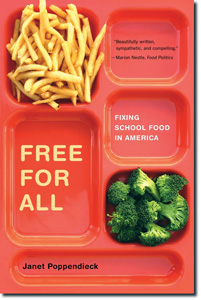
As deeper background reading, I greatly appreciate Janet Poppendieck's thoughtful book, Free for All: Fixing School Food in America (University of California Press).
For local eastern Massachusetts readers, I notice that Poppendieck is giving a free public lecture at Boston University (in the College of Arts and Sciences Building, Room 211, 725 Commonwealth Avenue, in Boston, on Tuesday, April 2, 6 pm).
Highlights, according to the FNS summary, include:
- More of the foods we should encourage. Promoting availability of healthy snack foods with whole grains, low fat dairy, fruits, vegetables or protein foods as their main ingredients.
- Less of the foods we should avoid. Ensuring that snack food items are lower in fat, sugar, and sodium and provide more of the nutrients kids need.
- Targeted standards. Allowing variation by age group for factors such as beverage portion size and caffeine content.
- Flexibility for important traditions. Preserving the ability for parents to send in bagged lunches of their choosing or treats for activities such as birthday parties, holidays, and other celebrations; and allowing schools to continue traditions like occasional fundraisers and bake sales.
- Reasonable limitations on when and where the standards apply. Ensuring that standards only affect foods that are sold on school campus during the school day. Foods sold at an afterschool sporting event or other activity will not be subject to these requirements.
- Flexibility for state and local communities. Allowing significant local and regional autonomy by only establishing minimum requirements for schools. States and schools that have stronger standards than what is being proposed will be able to maintain their own policies.
- Significant transition period for schools and industry. The standards will not go into effect until at least one full school year after public comment is considered and an implementing rule is published to ensure that schools and vendors have adequate time to adapt.
To me, a fundamental issue is that schools are supposed to act with the child's interest at heart. No matter what your view about other health policy proposals to regulate food sales (such as sales of soda in New York City movie theaters for example), we should all recognize that schools are different. This is not a question of regulatory overreach. This is a question about whether adults in publicly funded institutions should be making money for education programs by selling high-calorie snacks and sugary beverages to young children in the midst of widespread health concerns about childhood obesity.
Current information resources include earlier coverage on this blog, the FNS site, and (if you want to see an example of suggested comments from a leading public interest organization that has studied this issue closely) the Center for Science in the Public Interest (CSPI).
As deeper background reading, I greatly appreciate Janet Poppendieck's thoughtful book, Free for All: Fixing School Food in America (University of California Press).
For local eastern Massachusetts readers, I notice that Poppendieck is giving a free public lecture at Boston University (in the College of Arts and Sciences Building, Room 211, 725 Commonwealth Avenue, in Boston, on Tuesday, April 2, 6 pm).
Sunday, March 24, 2013
OMG! Sodium!

I showed this cereal box to my 10-year-old daughter at breakfast this morning, but she couldn't see the pun. At first, I thought maybe she didn't know the text message shorthand, OMG. On the contrary, she could only read the message, "Oh my God, sodium!"
Thursday, March 21, 2013
Virginia Tech seminar, March 22
I will be giving a departmental seminar in the Department of Agricultural and Applied Economics at Virginia Tech, tomorrow, March 22, at 3 pm.
The title is: "Not just for farmers: Six ways that agriculture programs affect food, nutrition, and the environment."
Please come visit if you are in Blacksburg, Virginia. The room is Fralin 102.
The title is: "Not just for farmers: Six ways that agriculture programs affect food, nutrition, and the environment."
Please come visit if you are in Blacksburg, Virginia. The room is Fralin 102.
Wednesday, March 20, 2013
Albany Law School professor Timothy Lytton has a new book, Kosher: Private Regulation in the Age of Industrial Food. A key point is that this topic is more broadly relevant than one might think, because kosher food is just one of many examples of food regulation systems that can be adopted by the private sector.
Lytton was interviewed on the What is Your Food Worth? blog.

Lytton was interviewed on the What is Your Food Worth? blog.
As a general matter, private food safety audits and industry-sponsored nutrition labeling schemes have been a great disappointment. Behind most major food-poisoning outbreaks is some private auditing firm that gave the food producer a phony five-star rating. And when nutritional rating schemes give high marks to sugary cereals and full-fat ice cream, you have to wonder.
As a kosher-observant Orthodox Jew, I realized that kosher certification offers a 2000 year old example of private food certification. My initial suspicion was that kosher certification was full of price gouging and unnecessary, super-stringent standards. As I began to get into my research, however, I found that, although fraud and corruption were rampant a century ago in kosher meat production, today’s kosher system is highly reliable. My book tells the story of how, within the span of a century, kosher certification became the one of the most reliable systems of private certification in the food industry, indeed, perhaps in any industry.
Tuesday, March 19, 2013
Michael Moss: Salt, Sugar, Fat
New York Times reporter Michael Moss's book released this year is Salt, Sugar, Fat: How the Food Giants Hooked Us.
The book has some older themes and some newer distinctive contributions. The basic indictment of highly palatable processed food is familiar to readers of Michael Pollan, Marion Nestle, Eric Schlosser, and David Kessler, and to viewers of movies such as Supersize Me and Food, Inc. The novelty and strength of Moss's new book is the persuasive on-the-record interviews with food industry executives and scientists as they try to understand the consequences of their products and even to make improvements.
I ended up with two competing impressions. First, I felt sympathetic to the industry scientists and executives, several of whom really would have preferred to sell better products, but who were defeated by competitive pressures. Second, it seemed that the industry people themselves are usually naive about the possibility of making substantial improvements on a company-by-company voluntary basis. I say "usually" naive, because I think deep down they know their efforts are partly for show, and at key junctures the industry scientists and executives are forced to be blunt about the real situation.
I have seen this pattern in my own conversations with food industry scientists and executives. In nine sentences out of ten, they will express great optimism that their company can make healthy changes in its product mix. Then, in the tenth sentence, especially if pressed with a hard question about whether the proposed changes are sufficiently ambitious to make a real difference, they will say, "Oh, well, don't be unrealistic. You can't expect THAT from us in the real world of competition."
An article-length version of the book was published in the New York Times Magazine. The Grocery Manufacturers Association released a statement treating Moss's book as an "obesity book" with an unfair axe to grind: "Michael Moss’s work misrepresents the strong commitment America’s food and beverage companies have to providing consumers with the products, tools and information they need to achieve and maintain a healthy diet and active lifestyle." But this statement misses a key theme of Moss's book, which focuses above all on the quixotic efforts of industry scientists and executives to make improvements.

The book has some older themes and some newer distinctive contributions. The basic indictment of highly palatable processed food is familiar to readers of Michael Pollan, Marion Nestle, Eric Schlosser, and David Kessler, and to viewers of movies such as Supersize Me and Food, Inc. The novelty and strength of Moss's new book is the persuasive on-the-record interviews with food industry executives and scientists as they try to understand the consequences of their products and even to make improvements.
I ended up with two competing impressions. First, I felt sympathetic to the industry scientists and executives, several of whom really would have preferred to sell better products, but who were defeated by competitive pressures. Second, it seemed that the industry people themselves are usually naive about the possibility of making substantial improvements on a company-by-company voluntary basis. I say "usually" naive, because I think deep down they know their efforts are partly for show, and at key junctures the industry scientists and executives are forced to be blunt about the real situation.
I have seen this pattern in my own conversations with food industry scientists and executives. In nine sentences out of ten, they will express great optimism that their company can make healthy changes in its product mix. Then, in the tenth sentence, especially if pressed with a hard question about whether the proposed changes are sufficiently ambitious to make a real difference, they will say, "Oh, well, don't be unrealistic. You can't expect THAT from us in the real world of competition."
An article-length version of the book was published in the New York Times Magazine. The Grocery Manufacturers Association released a statement treating Moss's book as an "obesity book" with an unfair axe to grind: "Michael Moss’s work misrepresents the strong commitment America’s food and beverage companies have to providing consumers with the products, tools and information they need to achieve and maintain a healthy diet and active lifestyle." But this statement misses a key theme of Moss's book, which focuses above all on the quixotic efforts of industry scientists and executives to make improvements.
Subscribe to:
Posts (Atom)